Inside the Sagrada Família: A Forest of Stone
Gaudí's lifework features tree-like columns and kaleidoscopic stained glass that create one of the world's most extraordinary interiors.
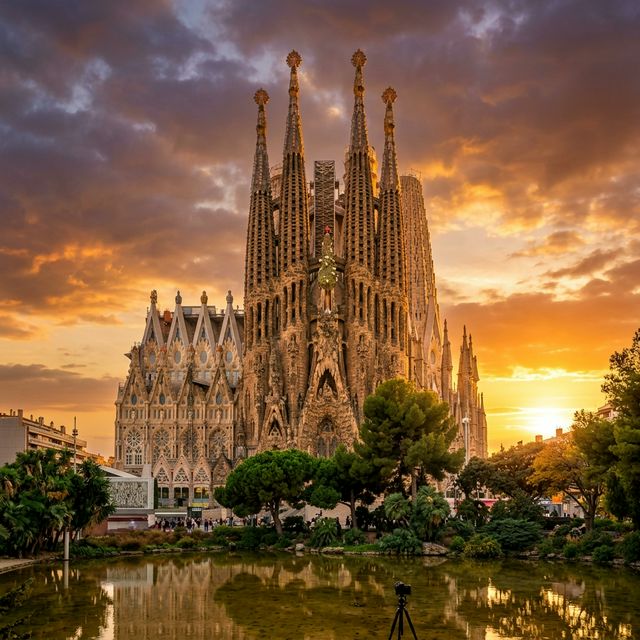
From Gaudí's soaring basilica to hidden Modernisme gems — everything you need to plan an unforgettable architectural journey through Barcelona.
Discover the buildings, parks, and hidden gems that make Barcelona one of the world's greatest architectural destinations.
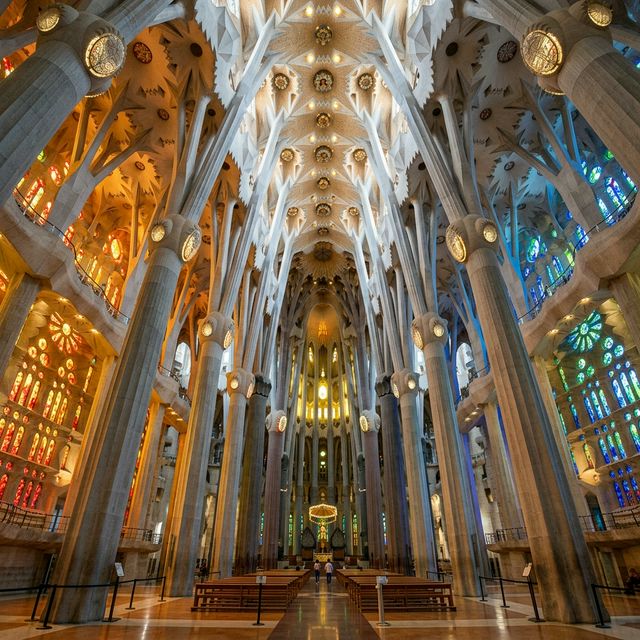
Gaudí's lifework features tree-like columns and kaleidoscopic stained glass that create one of the world's most extraordinary interiors.
The interior of the Sagrada Família is unlike any church you've ever seen. Gaudí designed the columns to branch like trees, creating a stone canopy that filters light through enormous stained glass windows on every side.
The Light: The east-facing windows cast cool blues and greens in the morning, while the west-facing ones glow with warm reds and oranges in the afternoon. Visit twice if you can — the experience changes completely.
The Columns: There are 36 branching columns supporting the roof, inspired by the geometry of trees. They range from porphyry at the base to basalt higher up, each made from a different stone depending on the weight it bears.
The Crypt: Beneath the nave lies the museum and crypt where Gaudí himself is buried. Here you can see his original plaster models and understand how he used hanging chain models to design the catenary arches.
Pro Tip: The first and last hours of the day offer the best light and smallest crowds. Stand in the centre of the nave and look up — the effect is breathtaking.
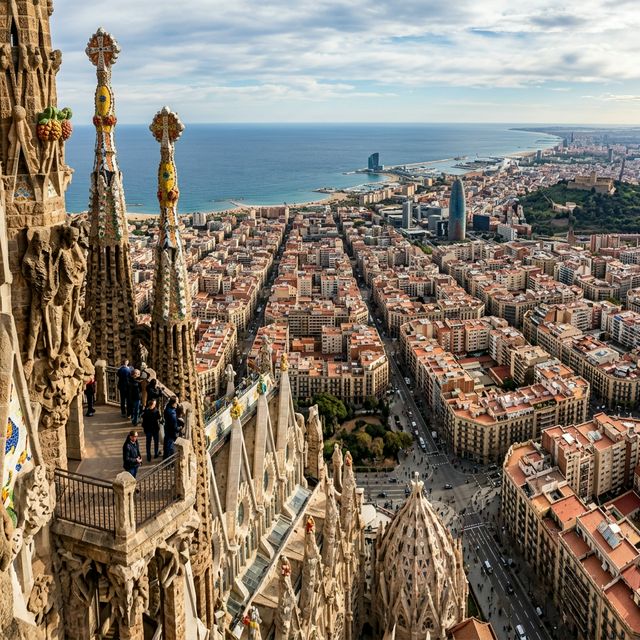
Ascend by elevator and descend through narrow spiral staircases for views stretching from the mountains to the Mediterranean.
The Sagrada Família has two sets of towers visitors can access — those on the Nativity Facade (east) and the Passion Facade (west). Each offers a distinct experience.
Nativity Facade Towers: The original towers designed by Gaudí. The descent through the narrow spiral staircase is thrilling, with close-up views of the intricate stone carvings and mosaic-topped pinnacles. Views face the rising sun and the Eixample district.
Passion Facade Towers: These offer views toward the sea and the older Gothic Quarter. The architectural style is more angular and modern, reflecting the sculptor Josep Maria Subirachs' interpretation.
Important: Tower access requires a separate ticket. You take a small elevator up and must walk down via a narrow, endless spiral staircase (approximately 400 steps). Not recommended for those with vertigo, claustrophobia, or mobility difficulties. Children under 6 are not permitted.
Best Photos: The Nativity towers at sunrise, the Passion towers at sunset. Bring a wide-angle lens — the details are incredible at arm's reach.
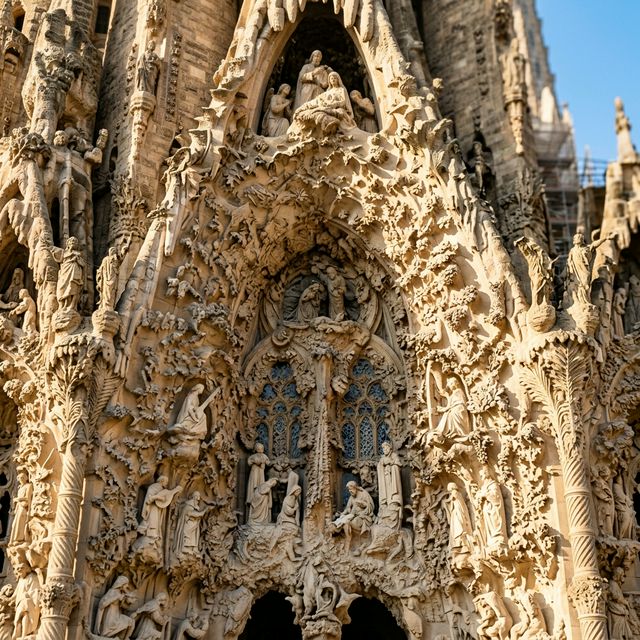
Each facade tells a different chapter of Christ's story through radically different artistic styles spanning 140 years of construction.
Nativity Facade (East): The only facade completed during Gaudí's lifetime. Overflowing with naturalistic details — turtles supporting columns, birds, plants, and musical angels. Gaudí used casts of real people and animals for the sculptures.
Passion Facade (West): Designed after Gaudí's death by sculptor Josep Maria Subirachs. The style is starkly minimalist — angular, hard-edged figures tell the story of Christ's suffering. The "magic square" hidden in the facade adds up to 33 (Christ's age at crucifixion) in every direction.
Glory Facade (South): Still under construction and planned to be the largest and most impressive of the three. It will represent humanity's path to God through death, final judgment, and glory. When completed, it will have a grand staircase descending to Carrer de Mallorca.
Detail to Find: On the Passion Facade, look for the cryptogram square — a 4×4 grid of numbers that always sums to 33, no matter how you add them.
Wander through colourful mosaic terraces, gingerbread gatehouse pavilions, and the famous dragon staircase in this hillside park.
Park Güell was originally planned as a luxury housing estate but was converted into a public park in 1926. It's now one of Barcelona's most beloved landmarks.
Highlights: The serpentine mosaic bench on the main terrace (offering stunning views over the city), the dragon (or salamander) staircase at the entrance, and the Hypostyle Hall with its 86 Doric columns.
Monumental Zone: The most famous features require a timed-entry ticket to the Monumental Zone. Access is limited to 1,400 visitors per hour to protect the site.
Free Areas: The surrounding park and garden areas are free and offer beautiful walking paths through Mediterranean vegetation. The Calvary at the top of the park provides the best panoramic view.
Getting There: Take Metro L3 to Lesseps or Vallcarca, then walk uphill (15-20 min) or take Bus 24 directly to the entrance. The walk is steep but scenic, with the city unfolding below you.
Three of Barcelona's most famous Modernista buildings stand side by side — Casa Batlló, Casa Amatller, and Casa Lleó Morera.
The "Manzana de la Discordia" (Block of Discord) is a stretch of Passeig de Gràcia where three rival architects each designed a building, competing to outdo each other.
Casa Batlló (Gaudí): The most famous of the three. Its undulating facade resembles bones and skulls, while the roof is designed to look like the back of a dragon. The interior is equally spectacular, with flowing organic forms throughout.
Casa Milà / La Pedrera (Gaudí): Just two blocks up, this building looks as though it was carved from a cliff. The rooftop terrace, with its surreal chimney warriors, is one of Barcelona's most iconic sights, especially at sunset.
Casa Amatller (Puig i Cadafalch): A blend of Gothic and Dutch architectural styles. Less visited than its neighbours, it offers fascinating tours of a perfectly preserved Modernista interior, including the original chocolate-making kitchen.
Walking Route: Start at Plaça Catalunya, walk up Passeig de Gràcia past all three buildings, then continue to La Pedrera. The walk takes about 15 minutes and is one of Barcelona's finest architectural promenades.
From a humble Catalan childhood to the architect who reinvented building physics — the extraordinary life story of Antoni Gaudí.
Antoni Gaudí i Cornet (1852-1926) is considered the greatest architect of Catalan Modernisme and one of the most original designers in the history of architecture.
Early Life: Born in Reus, Catalonia, Gaudí suffered from rheumatism as a child, which led him to spend long periods observing nature — an influence that permeated his entire career. He studied architecture in Barcelona, where his professors reportedly said: "We have given this diploma either to a madman or a genius."
Key Works: Seven of his buildings are UNESCO World Heritage Sites: Casa Vicens, the Nativity Facade of Sagrada Família, Casa Batlló, Casa Milà, Park Güell, Palau Güell, and the Colonia Güell crypt.
His Death: On June 7, 1926, Gaudí was struck by a tram while walking to confession. He was so shabbily dressed that taxi drivers refused to take him, assuming he was a beggar. He died three days later. Thousands attended his funeral procession to the Sagrada Família, where he is buried in the crypt.
Legacy: The Sagrada Família is expected to be completed in 2026, marking the centenary of Gaudí's death. It will have taken 144 years to build — longer than the Great Pyramid of Giza.
From Roman walls to medieval palaces, Barcelona's oldest neighbourhood is a living museum of architectural history.
The Barri Gòtic (Gothic Quarter) is the heart of Barcelona's old city, a labyrinth of narrow medieval streets, hidden squares, and buildings spanning two millennia.
Roman Remains: The Temple of Augustus (4 Corinthian columns hidden inside a building), sections of the Roman city wall, and an underground archaeological site beneath the Plaça del Rei reveal Barcelona's origins as the Roman colony of Barcino.
Barcelona Cathedral: The stunning Gothic cathedral (not to be confused with the Sagrada Família) dates from the 13th-15th centuries. Its cloister, with its 13 white geese, is one of Barcelona's most peaceful spots.
Hidden Gems: Plaça Felip Neri (a quiet square with shrapnel scars from the Spanish Civil War), the Bridge of Sighs on Carrer del Bisbe, and the tiny Plaça de Sant Just with its medieval fountain.
Best Way to Explore: Get deliberately lost. The Quarter rewards wandering — every turn reveals a new courtyard, a carved doorway, or a centuries-old wall. Early morning and late evening are magical.
Barcelona's food scene is legendary. Here are the best spots for tapas, seafood, and authentic Catalan cuisine near the main sights.
La Boqueria Market: Barcelona's most famous food market on La Rambla. Arrive early (before 10am) to avoid the crowds. Don't miss the juice bars, jamón ibérico stalls, and fresh seafood counters.
El Born: The trendy neighbourhood next to the Gothic Quarter is packed with excellent restaurants. Try Bar del Pla for creative tapas or El Xampanyet for traditional cava and anchovies.
Eixample: Near the Sagrada Família, the grid streets of the Eixample hide excellent local restaurants. Cervecería Catalana is famous for its tapas (expect a wait), while Flax & Kale offers plant-based innovation.
Must-Try Dishes: Pa amb tomàquet (bread with tomato), fideuà (noodle paella), patatas bravas, escalivada (roasted vegetables), and crema catalana (Catalan crème brûlée).
Budget Tip: Look for "menú del día" — a fixed-price lunch (usually €10-15) offered by most restaurants on weekdays. It typically includes a starter, main, dessert, bread, and a drink.
Metro, bus, bike, and walking — everything you need to navigate Barcelona efficiently and affordably.
Metro: Barcelona's metro (TMB) is fast, clean, and covers all major attractions. The key stop for the basilica is "Sagrada Família" (lines L2 and L5). Single tickets cost €2.40, but the T-Casual card (10 trips for ~€11.35) is much better value.
From the Airport: The Aerobus runs every 5 minutes from Terminal 1 and Terminal 2 to Plaça Catalunya (35 min, ~€7). Metro L9 Sud also connects the airport to the city centre.
Walking: The most popular architectural sights (Gothic Quarter → La Rambla → Passeig de Gràcia) are all within a 30-minute walk of each other. Wear comfortable shoes — Barcelona's pavements are beautiful but hard on the feet.
Biking: Barcelona's Bicing system is for residents only, but tourist bike rentals are widely available (from €10/day). The beachfront promenade and the Eixample's wide avenues are ideal for cycling.
Hola Barcelona Card: Unlimited transport for 2-5 days (from €16.40). Worth it if you're using public transport frequently.
Capture Barcelona's architecture like a professional with these spot-by-spot tips for lighting, angles, and composition.
Sagrada Família Exterior: The best angle is from Plaça de Gaudí (the park across the street) where you get the full facade reflected in the lake. Sunrise light on the Nativity Facade is magical.
Interior Light: Visit between 4-6pm when the afternoon sun hits the warm-coloured stained glass on the Passion side, flooding the nave with reds and oranges. Morning light through the Nativity side gives cool blues and greens.
Park Güell: The best photos are from the main terrace looking down over the mosaic bench with the city behind. Early morning (8-9am) avoids crowds and offers golden light.
Casa Batlló: The facade is best photographed from across the street in late afternoon light. At night, the subtle illumination makes it look like a living organism.
Equipment Tips: A wide-angle lens (16-35mm) is essential for interiors — the columns and ceilings are massive. A polarizing filter helps with the stained glass reflections. Tripods are generally not allowed inside, so increase your ISO and steady your elbows.
Barcelona's weather is excellent year-round, but each season offers a different experience. Here's how to choose.
Spring (March-May): The ideal time. Pleasant temperatures (15-22°C), blooming parks, manageable crowds. Late April/May is perfect for outdoor sightseeing.
Summer (June-August): Hot (30°C+) and very crowded. Beaches are packed, sights have long queues. But the long days and evening culture are wonderful. Plan indoor visits (like the basilica interior) during the hottest hours.
Autumn (September-November): Another excellent window. Warm weather, thinning crowds, lower prices. October is especially good — warm enough for outdoor dining, cool enough for comfortable walking tours.
Winter (December-February): Mild by European standards (8-15°C). Very few tourists, no queues, lowest hotel rates. The Christmas markets add festive charm. Indoor attractions are perfect for cooler days.
Our Recommendation: Late September to mid-October offers the best combination of weather, crowds, prices, and light for photography. Book architectural site visits at least 2 weeks in advance regardless of season.
The best neighbourhoods for easy access to Gaudí's masterpieces and Barcelona's Modernista heritage.
Eixample (near Sagrada Família): The most convenient base for an architecture-focused trip. Grid streets, excellent restaurants, and walking distance to Casa Batlló, La Pedrera, and the basilica. Moderate to high prices.
El Born: Trendy, artistic neighbourhood near the Gothic Quarter. Boutique hotels, craft cocktail bars, and excellent street food. A short metro ride to the basilica.
Gothic Quarter: Atmospheric medieval streets, central location, close to La Rambla and the cathedral. Hotels can be noisy due to nightlife. Budget to mid-range.
Gràcia: Local, bohemian vibe away from the tourist crowds. Closest to Park Güell and has some of Barcelona's best neighbourhood squares. More affordable than central areas.
Pro Tip: The L2 and L5 metro lines connect most major sights. Choose a hotel near one of these lines for maximum flexibility.
Practical advice to make the most of your architectural tour.
As a working basilica, shoulders and knees must be covered for entry. Comfortable walking shoes are essential — you'll cover a lot of ground exploring the architecture. Bring sunscreen and a hat in summer.
The basilica interior is fully wheelchair accessible. However, tower access involves narrow spiral staircases with no elevator down — not suitable for mobility-impaired visitors. Park Güell's Monumental Zone is partially accessible.
Barcelona is bilingual — both Catalan and Spanish are official. Signs and menus are typically in Catalan, but everyone speaks Spanish and most people in tourist areas speak English. A few phrases in Catalan (like "gràcies" for thank you) go a long way.
Quick answers to common questions about Barcelona's architecture.
Tell us about your trip and we'll create a personalised guide to Barcelona's best architectural experiences.
Fill in the form and we'll email you a tailored itinerary.